
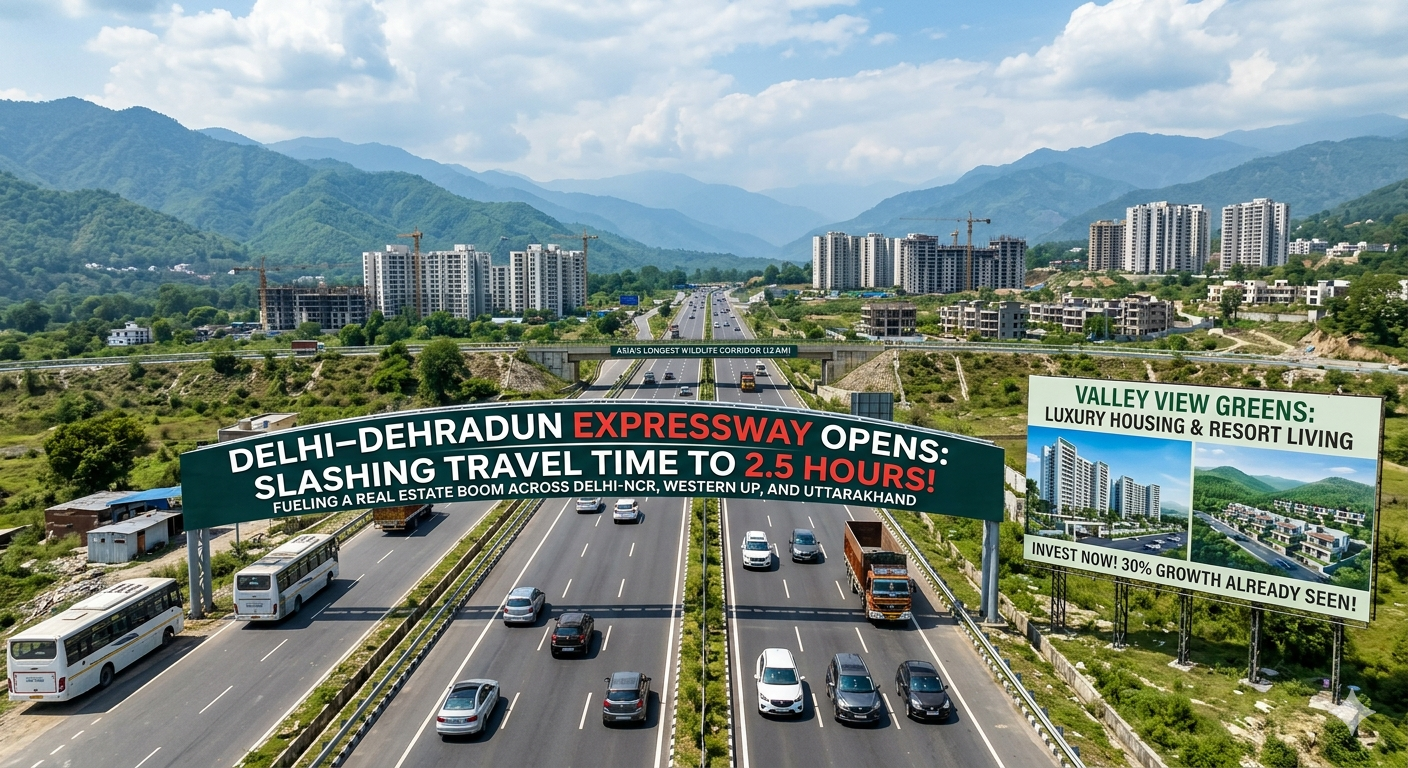
The Delhi–Dehradun Expressway, inaugurated on April 14, 2026, is a transformative 210 km infrastructure project that has revolutionized connectivity between the national capital and Uttarakhand. By slashing travel time from over six hours to approximately 2.5 hours, the expressway has not only eased travel but also ignited a significant real estate boom across its entire corridor, spanning three states: Delhi, Uttar Pradesh, and Uttarakhand.
The Expressway Overview: A Landmark in Connectivity
Constructed under the National Highways Authority of India (NHAI) as part of the Bharatmala Pariyojana, this six-lane access-controlled expressway begins at Akshardham in East Delhi and terminates in Dehradun. It features Asia’s longest elevated wildlife corridor (12 km) over Rajaji National Park and two major tunnels near Daat Kali. The route connects several significant cities, including Baghpat, Shamli, and Saharanpur in Uttar Pradesh, creating a new economic artery for the region. A 51-km greenfield spur also connects the expressway directly to Haridwar, further enhancing pilgrimage and tourism access.
Real Estate Impact: A Regional Appraisal
The core effect of the expressway has been to compress geography, making previously distant areas commercially and residentially viable. Experts and developers have observed a simultaneous re-rating of property values across the three states, with different investment profiles and price points emerging in distinct zones.
1. Delhi-NCR Belt: Enhanced Accessibility and Re-rating
The starting point of the expressway has significant implications for Northeast Delhi and adjacent parts of the National Capital Region. In Delhi, areas such as Akshardham, Geeta Colony, Shastri Park, Sonia Vihar, and Loni are experiencing improved urban connectivity. In the nearby NCR-linked micro-markets, including Sahibabad, Shahdara, Seemapuri, Narela, and Bawana, strong residential demand has been observed, particularly from end-users seeking proximity to Delhi. Price appreciation in these established markets is projected at 15-20% over the next 18-24 months. The residential market is characterized by builder floors and apartments.
Notably, Ghaziabad has seen a dramatic impact. Following the expressway’s launch, the city witnessed a 30% surge in property prices. Previously considered an “affordable alternative,” Ghaziabad is now attracting luxury homebuyers and high-net-worth investors, drawn by the high-speed corridor and reduced commuting times to Delhi and Noida. Primary beneficiaries include Siddharth Vihar, Raj Nagar Extension, and the NH-24 belt, where demand for luxury 3 and 4 BHK homes is high.
2. Western Uttar Pradesh Corridor: Plotted Developments and Long-term Gain
The expressway traverses 118 km of greenfield land through western Uttar Pradesh, linking Delhi to Baghpat, Baraut, Shamli, and Saharanpur. This corridor is now attracting early investors looking for high upside potential. Prominent real estate growth is anticipated in Baghpat, Shamli, and Saharanpur, driven by improved connectivity. This region offers entry-level investors and end-users plotted developments, farmland, and potential for industrial parks at relatively accessible price points. Expected appreciation in these emerging zones is estimated at 20-30% in the next 18-24 months. In Saharanpur, residential development is pick up near the Saharanpur Bypass, affecting localities like Lakshman Puri, Sharda Nagar, Vasant Vihar, Ramnagar, and Navin Nagar.
3. Uttarakhand Gateway: Lifestyle and Second Homes
The terminus in Uttarakhand, encompassing Dehradun, Rishikesh, and the Mussoorie foothills, is experiencing a different kind of real estate surge. The “lifestyle factor” is the main driver here, with demand rising for second homes, vacation homes, and studio apartments. This trend is fueled by the rapid migration from Delhi-NCR, the hybrid work paradigm, and a growing interest in investing in scenic, hill-station locations.
Even before the expressway’s inauguration, Dehradun recorded a sharp price appreciation of 30.9% year-on-year in late 2025, indicating that the market was already pricing in the anticipated connectivity boost. Currently, holiday homes are in the range of ₹30-₹70 lakh, while studio apartments are attractive in the ₹20-₹35 lakh bracket. Key investment hotspots in Dehradun include Rajpur Road, Sahastradhara Road, and Doiwala. In Rishikesh, areas near the bypass are gaining traction. The market is also seeing a shift towards organized, RERA-regulated, gated communities with 2BHK and 3BHK configurations, rather than unplanned land parcels.